 is here! Shop now, pay later in 4 easy installments


Last Updated: October 30, 2026
Quick Summary
Expensive boxing gloves are worth it when you train often, because the extra money buys leather casings, consistent padding density and better wrist bracing that cheap gloves cannot match. If you train fewer than twice a week, budget or entry gloves are enough.
- Leather casings resist creasing and flaking where synthetic splits, making them the biggest factor in glove lifespan.
- Train three or more times weekly on the bag and you should buy mid tier minimum for padding density and palm reinforcement.
- Spending more will not fix a bad fit, so match hand measurements to the size chart before choosing a price tier.
- Replace gloves when knuckle foam feels flat or lumpy, the wrist strap no longer locks, or the casing cracks.
- Never store damp gloves in a gym bag overnight, as one sealed sweaty night damages foam more than a week of bag work.
Table of Contents
- Cheap vs Expensive Boxing Gloves: What Actually Changes
- Boxing Glove Price Guide: What Each Tier Delivers
- Best Boxing Gloves for Beginners Without Overspending
- How Often to Replace Boxing Gloves
- Cost Per Use: The Long-Term Value Calculation
- Choosing Your Pair at Pro Fight Store
- Frequently Asked Questions
Cheap vs Expensive Boxing Gloves: What Actually Changes
If you are weighing up whether expensive boxing gloves are worth it, the short answer is this: the money buys materials, padding consistency and construction that cheap gloves cannot match, and it shows up in how your hands feel after round six. At PRO FIGHT STORE AUSTRALIA, we sell gloves from $113.99 to $329.99, so we have a clear view of what separates each tier. Below, we break down exactly where the extra money goes, and when you can safely skip it.
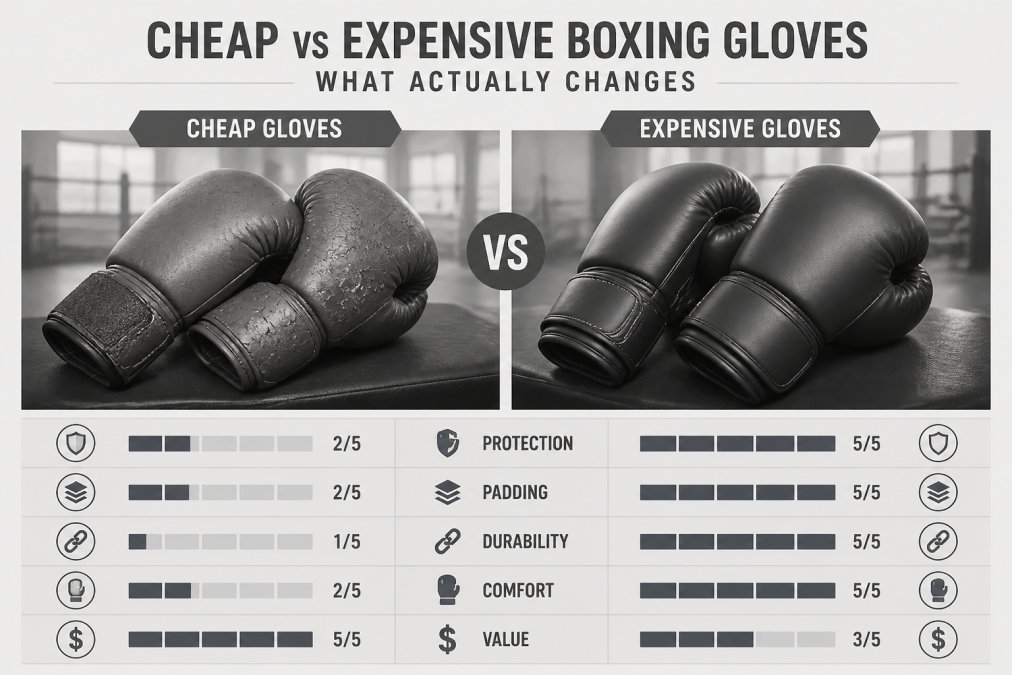
Leather vs Synthetic Casings
Leather is the first real dividing line. Leather moulds to your hand over time and holds its shape.
Our Siam™ gloves use 1.1mm elite cowhide leather, which is built for durability in sparring and training.
Padding Density and Knuckle Protection
Padding density matters more than padding thickness. Cheap gloves pad generously but unevenly, so the foam compresses into lumps over the knuckles within months.
The Trophy Getters® line uses crush-tested 3-tonne memory injected moulded padding. If knuckle protection is your main concern, a gel knuckle protector adds a layer under the wrap without changing the glove.
Boxing Glove Price Guide: What Each Tier Delivers
Below is a general guide to how glove price bands differ in Australian dollars and who each band tends to suit.
| Tier | Typical Price (AUD) | What Actually Changes | Who It Suits |
|---|---|---|---|
| Budget | Under $80 | Synthetic casing, glued seams, soft uniform foam, short wrist strap | Fitness classes, occasional bag work, shared gym gloves |
| Entry | $80 - $130 | Genuine leather casing, moulded padding, wrist strap, basic lining | Beginners training 2-3 times a week |
| Mid | $130 - $200 | Reinforced palm, denser multi-layer foam, wider hand compartment, longer warranty | Regular training and controlled sparring |
| Premium | $200 - $330 | Hand-cut or layered padding, anatomical last, lace-up or dual-closure bracing, premium lining | Frequent sparring, competition prep, high-volume bag work |
| Boutique | $330+ | Custom fit, exotic leathers, hand-stitched construction, limited production | Sponsored or committed competitors where fit is paramount |
Where the Money Actually Goes
The jump from budget to entry buys you the casing. Leather resists creasing and flaking where synthetic splits, and that single change is the biggest determinant of lifespan. The jump from entry to mid buys you padding consistency and palm reinforcement, the two things that decide whether the glove survives a year of hard hooks. The jump from mid to premium buys you shaping and closure: an anatomical last that keeps your knuckles aligned, and lace-up or dual-strap bracing that stops the wrist rolling under impact. For a high-end leather example, see the Mexican Fuerte Elite Gloves.

Decision Thresholds
- Train fewer than twice a week: budget or entry. You will not wear out a glove before the foam ages, so premium construction is wasted.
- Train three or more times weekly on the bag: mid tier minimum. The padding density and palm reinforcement are what stop knuckle soreness accumulating.
- Spar regularly: premium. The shaping and wrist bracing reduce the chance of the glove shifting on impact, which is when hands and partners get hurt.
- Compete: premium or boutique, and get the fit right before the price right.
What Price Does Not Buy
Spending more will not fix a bad fit. A $329.99 glove that pinches across the knuckles is worse for your hands than a $113.99 glove that fits properly. Price also does not buy injury immunity: no glove prevents all hand injuries, and padding only distributes force, it does not eliminate it. Fit, wrapping technique and training load matter as much as the price tag.
Use-Case Segmentation
- Bag work: mid tier. You want dense, consistent padding and a secure wrist strap; you do not need competition shaping.
- Sparring: premium. Shaping, closure and padding consistency protect both hands.
- Fitness classes: entry. Gloves are used briefly and lightly; durability matters more than feedback.
- Competition: premium or boutique, fitted to your hand shape.
Best Boxing Gloves for Beginners Without Overspending
Our Trophy Getters® gloves at $113.99 are one option for a first pair. They carry a 2-year workmanship warranty and a lifetime material warranty on the reinforced palms. Pair them with affordable handwraps and you have a complete starter setup for well under the cost of one premium glove.
How Often to Replace Boxing Gloves
But lifespan is not fixed, it is largely a function of how you care for the glove between sessions. This is the part most buyers ignore, and it is where the real cost of ownership hides.
The Real Replacement Signals
Replace gloves when the foam over the knuckles feels flat or lumpy, when the wrist strap no longer locks tight, or when the casing cracks at the crease. Appearance is a poor guide: a scuffed glove with intact padding is still serviceable, while a clean glove with compressed foam is not. Press your thumb into the knuckle padding; if it bottoms out against your hand, the glove is done regardless of how it looks.
PUNCH EQUIPMENT BOXING GLOVES - Siam™ - LEATHER - BLACK - 16OZ →
Care, Drying and Storage
After every session:
- Wipe the lining with a damp cloth and mild soap, then dry the inside thoroughly.
- Air-dry in a ventilated space, never in a sealed bag or direct sun.
- Use a glove deodoriser or cedar insert to absorb residual moisture and odour.
- Store loosely packed so the glove holds its shape rather than creasing.
Do Premium Gloves Need Different Upkeep?
Yes, in two ways. Leather casings benefit from occasional conditioning to stop drying and cracking, particularly in dry climates; a light leather balm every few months is enough. Lace-up gloves need the laces checked and replaced before they fray, and the extra eyelets and tongue mean more places for moisture to sit. Synthetic gloves need less conditioning but degrade faster once the casing cracks, so early retirement is more common.
Repairability and Long-Term Ownership
Most glove repairs are limited to laces, straps and linings; foam and casing failures are not economically repairable. That is why the care routine matters more than any repair option: you are protecting the parts that cannot be fixed. A premium glove that is dried and stored properly can outlast two or three budget pairs, which is where the cost-per-use argument in the next section becomes concrete.
A Simple Maintenance Budget
Factor in a modest ongoing cost: a deodoriser, a leather balm and replacement laces every year or so. Spread across the life of the glove, this is a small fraction of the purchase price, but skipping it is the most common reason gloves are retired early, and it erodes the value advantage premium gloves are supposed to deliver.
Cost Per Use: The Long-Term Value Calculation
A simple way to compare gloves is to divide the price by the number of sessions you expect to train in. Gloves used more often spread their cost across more sessions.
Choosing Your Pair at Pro Fight Store
Fit and hand shape decide more than price. A glove that pinches across the knuckles or leaves your thumb exposed will cause problems no matter what you paid.
Measure your hand around the palm, match it to the size chart, and always try the closure system you will actually use. Our 16oz leather Siam™ sparring glove is a sparring option, and the Mexican™ Elite at $229.00 is a Mexican-style glove for sparring and drills.

Frequently Asked Questions
Are expensive boxing gloves more protective?
The Punch Trophy Getters, for example, use 3-tonne crush-tested memory injected moulded padding and a 3-inch full wrap wrist strap. That said, protection depends on matching glove weight and padding type to your training. A $114 pair built for bag work protects better than a $330 lace-up sparring glove used on the heavy bag.
Do premium boxing gloves last longer?
The Punch Siam gloves use 1.1mm elite cowhide leather. The Trophy Getters and Mexican Elite models carry a 2-year workmanship warranty.
How much should I spend on boxing gloves as a beginner?
The Punch Trophy Getters at $113.99 come with a 2-year workmanship warranty and a lifetime material warranty on the reinforced palms. The Punch Siam at $169.99 is a 16oz leather sparring glove with a wider hand profile.
How often should I replace boxing gloves?
Replace boxing gloves when the padding compresses and stops springing back, the lining tears, or the closure stops holding firm.
The real question is not whether expensive gloves cost more, but whether your training volume justifies them. If you train hard and often, the padding, leather and wrist support in a premium pair protect your hands and last longer. If you are starting out, entry-level leather gets you moving without waste. Get started with PRO FIGHT STORE AUSTRALIA and find gloves matched to how you actually train, with free freight on orders over $100.00.
